If you’re already a Redline client, you’ll know we often look beyond surface-level SEO tactics. Keywords, titles, and backlinks all matter, but they rarely explain the full picture.
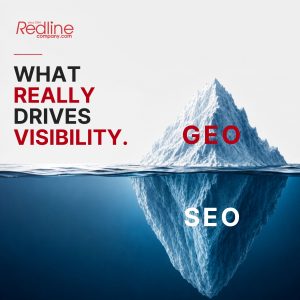
Search visibility and website ranking are often discussed in terms of these elements, but this only tells part of the story. In reality, both SEO (Search Engine Optimisation) and GEO (Generative Engine Optimisation) operate more like an iceberg. What you see on the surface is only a small fraction of what determines success.
Most of the work that truly influences visibility happens beneath the surface, out of sight and often overlooked.
Key Takeaways
- Surface-level SEO is necessary, but it rarely creates a competitive advantage
- Structure and clarity help search engines and AI systems properly understand your content
- Authority and trust are built over time and drive long-term visibility
- GEO builds on existing SEO foundations rather than replacing them
- Sustainable growth comes from depth, not just increased activity
The Tip of the Iceberg: The Visible Work
At the top of the iceberg are the elements that are easiest to identify and measure. Many guides explaining how to do SEO focus almost entirely on these visible elements because they are easier to implement and measure. These include keywords, meta descriptions and headings etc. They are often the first things people focus on because they are straightforward to implement and offer a sense of control.
In the context of GEO, this visible layer has expanded slightly. It now includes attempts to structure content for AI systems, such as adding FAQ sections or writing in a way that appears “AI-friendly” (as illustrated in this article). These approaches are increasingly common, but they remain surface-level.
Typical activities at this level include:
- Keyword placement in titles and headings
- Writing meta descriptions
- Traditional SEO tekstforfatning techniques designed to improve visibility
- Formatting content for readability
- Publishing regular blog content
- Adding FAQ-style or “AI-friendly” sections
While these elements are important, they rarely provide a lasting advantage. They are better understood as a baseline, necessary for participation, but not enough to stand out.
Beneath the Surface: Structure and Meaning
Just below the surface lies a more substantial and influential layer of optimisation. This is where search engines and AI systems begin to interpret your content rather than simply scan it. At this level, the focus shifts towards how your content is organised and how well it aligns with what people are actually looking for.
A clear site structure, logical internal linking and comprehensive coverage of a topic all contribute to this understanding. Rather than relying on individual keywords, effective content demonstrates relevance through context, depth and coherence.
This typically involves:
- Clear site structure and internal linking
- Content that covers topics in depth
- Alignment with user intent rather than just keywords
- Consistent messaging across your website and other platforms
For GEO, this layer becomes even more significant. AI systems are designed to process information in a more holistic way. They look for clear signals about who you are, what you offer, and how your content connects to broader topics. Consistency across your website and other platforms helps reinforce this understanding, making it easier for systems to interpret your content accurately.
This is the point at which optimisation becomes less about technical tweaks and more about communication. The question is no longer “Have I used the right keywords?” but “Is this genuinely clear and useful?” This is often where we see the biggest shift for clients; moving from isolated pieces of content to a more connected, strategic approach that search engines and AI systems can properly understand.
The Hidden Depths: Authority and Trust
The largest and most important part of the iceberg sits far below the surface. This is where long-term visibility is truly determined. Here, the focus is on authority, credibility and trust-factors that cannot be easily adjusted or manufactured overnight. These include your reputation, how often you are mentioned or referenced elsewhere, and whether your content demonstrates real expertise.
Search engines have long considered these signals, but they are even more critical in the age of AI. Generative systems do not simply rank pages; they assess and synthesise information from multiple sources. As a result, they tend to favour content that appears reliable, widely recognised, and genuinely informative. These are the kinds of signals that search engines and Google algorithms increasingly rely on when determining visibility and authority.
This means that being part of the wider conversation matters. Mentions across different platforms, consistent messaging, and original contributions all strengthen your position. Equally, user behaviour, such as whether people engage with your content or return to it, plays a role in reinforcing trust. Unlike surface-level optimisation, these signals develop over time. They are the result of sustained effort rather than quick fixes.
In practice, this is also the area that tends to separate short-term gains from sustained growth. It’s where consistent strategy, not quick wins, starts to compound.
How GEO Changes the Landscape
The rise of GEO has not replaced SEO, but it has shifted the balance. Traditional SEO focused heavily on ranking individual pages. GEO, by contrast, is more concerned with identifying trustworthy sources of information. AI systems are designed to combine insights, compare perspectives and prioritise content that aligns with established knowledge. They are less influenced by isolated tactics and more responsive to overall credibility.
As a result, the deeper layers of the iceberg carry greater weight than ever before. Surface-level optimisation still has a role, but it is no longer the primary driver of visibility. At the same time, it’s important not to treat GEO as a complete departure from SEO. Much of what is now being framed as “optimising for AI” is built on the same foundations we’ve been developing for years—clear structure, strong content, and consistent signals of authority.
While there is a rush to adapt to new formats and platforms, the underlying principles have not changed. In many cases, businesses that have invested in solid SEO over time are already well positioned. GEO does not replace that work—it builds on it.
A More Effective Approach
A common mistake is to concentrate too heavily on what is visible while neglecting what lies beneath. Many businesses focus primarily on how to optimise content for SEO without considering the wider trust and authority signals that influence long-term visibility.
A more effective approach is to focus on building a strong foundation. This is typically where a more strategic, joined-up approach makes the difference; aligning content, structure and brand signals so they reinforce one another over time. A strong SEO content strategy helps ensure these elements work together consistently rather than as isolated activities.
As Digital Marketing Manager at Redline Company, Victoria Rodgers explains: “In practice, this is also the area that tends to separate short-term gains from sustained growth. It’s where consistent strategy, not quick wins, starts to compound. The businesses that perform best in search aren’t usually the ones doing the most optimisation tricks, they’re the ones creating the clearest, most trusted and most consistent presence over time. That’s what both search engines and AI systems are increasingly rewarding.”
In conclusion, the iceberg analogy highlights a simple but important reality: what drives visibility is largely hidden. The visible elements of SEO and GEO are necessary, but they are only the starting point. Real progress comes from the deeper work, providing straightforward information, building authority and earning trust over time.
As search continues to evolve, particularly with the growing influence of AI, this hidden layer is becoming increasingly decisive. Those who invest in it will find that they rely less on surface-level tactics, and more on a foundation that is difficult to replicate.
If you’re unsure how much of your current strategy sits above or below the surface, it’s often worth taking a step back and reassessing. The biggest opportunities are usually not in what you’re already doing, but in what’s being overlooked.
What is the difference between SEO and GEO?
SEO (Search Engine Optimisation) focuses on improving website visibility in traditional search engines like Google through keywords, technical optimisation, backlinks and content quality. GEO (Generative Engine Optimisation) focuses on optimising content for AI-powered search systems and generative engines (such as ChatGPT) that summarise and recommend information rather than simply ranking webpages.
What is Generative Engine Optimisation (GEO)?
Generative Engine Optimisation (GEO) is the process of creating and structuring content so AI systems can better understand, reference and present it in AI-generated responses. GEO builds on traditional SEO (Search Engine Optimisation) foundations by prioritising clarity, authority, topical relevance and trustworthiness.
Is GEO replacing SEO?
No, GEO is not replacing SEO, it is evolving from it. Traditional SEO (Search Engine Optimisation) remains essential for search visibility, while GEO expands optimisation strategies to include AI-driven search experiences and generative search tools.